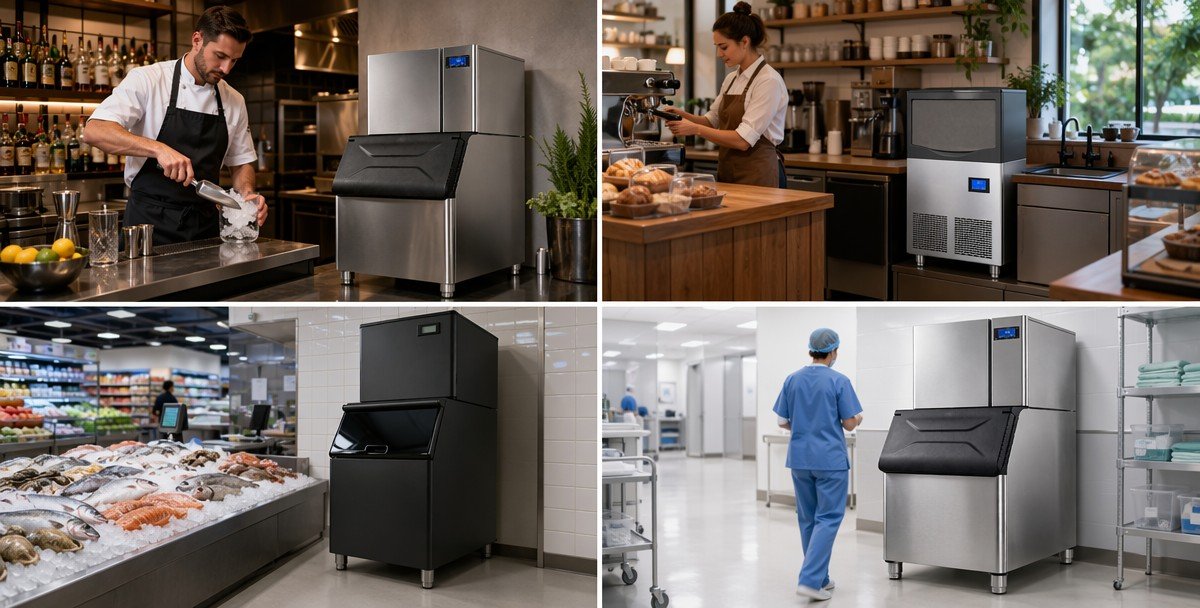
In the seafood and food processing industries, ice is more than just a cooling agent; it is a critical tool for preservation, quality control, and visual merchandising. Choosing a flake ice machine for seafood can mean the difference between a premium product that commands a high price and significant spoilage that eats into your margins. This guide compares the three primary ice types and explores why flake ice remains the undisputed champion of the industrial food sector.
Why Ice Type Matters for Seafood and Food Processing
Seafood is incredibly delicate. Unlike a bottle of soda or a crate of bottled water, fresh fish and shellfish require an ice that provides maximum surface contact while being gentle enough not to damage the skin, scales, or flesh. Using the wrong ice can lead to “bruising,” punctures, or dehydration of the product. When comparing flake ice vs nugget ice or cube ice, the physical properties of the ice—its shape, temperature, and moisture content—play the most significant role in food safety and shelf-life extension.
In food processing, such as sausage making or dough mixing, ice is often used as a direct ingredient to control heat generated by friction. In these cases, the ice must be able to melt quickly and evenly without leaving hard “hot spots” or damaging the mixing blades.
Flake Ice: The Gold Standard for Seafood
A commercial flake ice machine produces thin, flat pieces of ice that are irregularly shaped. Unlike other ice types that are formed in molds, flake ice is “harvested” by a rotating blade scraping ice off the inside of a frozen drum. Here is why it is the industry favorite:
1. Maximum Surface Area
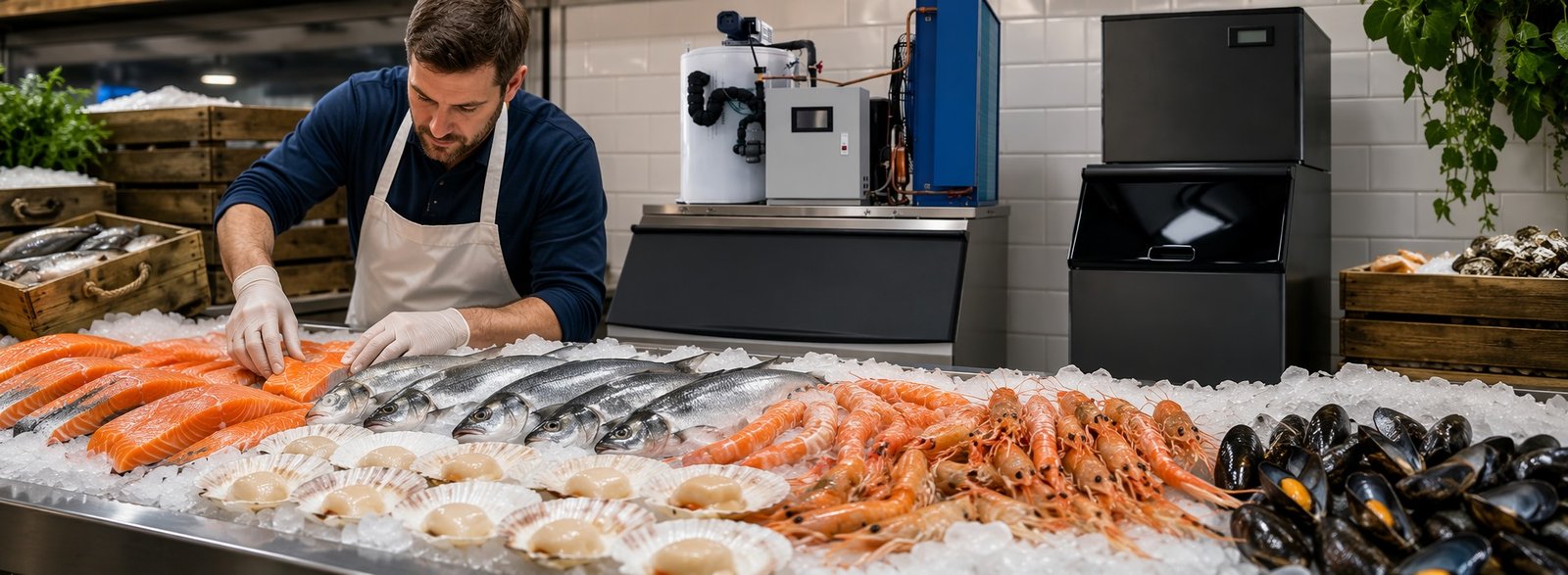
Because it is flat and thin (usually 1.5mm to 2.2mm), flake ice wraps around the product perfectly. This provides nearly 100% surface contact, allowing for the fastest possible heat transfer. In the seafood business, the faster you can lower the core temperature of a fish, the longer it will stay fresh.
2. Gentle Texture and Softness
Flake ice has no sharp edges. This is vital for fish display and processing, as it won’t puncture the delicate skin of a trout or tear the flesh of a fillet. It acts like a soft bed, supporting the weight of the product without causing physical damage.
3. Sub-cooled Temperature and “Dryness”
Flake ice is produced at a sub-cooled temperature of roughly -7°C. This makes it “dry” ice that does not clump together. It flows easily through shovels and pneumatic delivery systems, making it ideal for large-scale industrial operations where ice needs to be moved across a factory floor.
Nugget Ice and Cube Ice: Where Do They Fit?
While a commercial nugget ice machine is excellent for beverages and healthcare, it has severe limitations in industrial seafood settings. Nugget ice is “wet” ice (roughly 80% ice content). It tends to clump when stored in large quantities and doesn’t provide the same “blanket” effect as flake ice. It also melts into a slush faster, which can cause seafood to sit in a pool of water—a major sanitation risk.
Similarly, a commercial cube ice machine produces ice that is far too bulky for seafood display. Cubes leave large air gaps between the ice and the fish, leading to uneven cooling. Furthermore, the hard, sharp edges of a cube can easily bruise or mark the fish, lowering its market value.

Ice Type Comparison Table: Seafood & Industrial Use
| Metric | Flake Ice | Nugget Ice | Cube Ice |
|---|---|---|---|
| Shape | Flat, thin flakes | Small cylindrical nuggets | Solid square blocks |
| Cooling Speed | Instantaneous | Fast | Moderate |
| Product Safety | Highest (soft/flat) | Medium (small/round) | Low (hard/sharp edges) |
| Surface Contact | Excellent (95%+) | Good (~60%) | Poor (~30%) |
| Temperature | -7°C (Dry/Sub-cooled) | -1°C (Wet/Soft) | 0°C (Hard/Clear) |
| Primary Use | Seafood, Meat, Labs | Beverages, Healthcare | Bars, Hotels, Cafes |
Saltwater vs. Freshwater Flake Ice Machines
As a professional ice machine manufacturer, we often help clients choose between freshwater and saltwater models. This choice depends entirely on your location and application.
- Freshwater Flake Ice: Used in supermarkets, restaurants, and inland processing plants. It is made from standard potable water.
- Saltwater (Seawater) Flake Ice: Essential for fishing vessels at sea. These machines are built with anti-corrosive materials (316 stainless steel) to handle the harsh marine environment. Saltwater ice has a lower freezing point and is even softer than freshwater ice, providing “super-cooling” for fish caught far from shore.
Flake Ice in Other Food Processing Industries
Beyond the fish market, an industrial flake ice machine is essential in several other high-stakes sectors:
- Dough Mixing (Bakery): High-speed industrial mixers generate significant heat through friction. If the dough gets too warm, the yeast activates too early. Flake ice is added to the mix to absorb this heat instantly, melting away into the dough without leaving any hard chunks.
- Meat Processing (Sausage/Emulsion): Used in bowl cutters to keep the meat temperature below 12°C. This prevents the fat from separating and ensures a smooth, consistent texture in sausages and deli meats.
- Medical & Laboratory: Used for rapid cooling of chemical reactions and for transporting organs or biological samples. Its ability to contour perfectly to a container makes it superior to any other ice type for lab work.
- Concrete Cooling: In large-scale construction (like dams), flake ice is mixed with concrete to prevent it from cracking due to the heat generated during the curing process.
The AZ-FIM Series: Built for Heavy-Duty Cooling
At VendMachinery, we specialize in commercial ice machine for food processing solutions. Our AZ-FIM series is designed for 24/7 operation in demanding environments.
- Capacities: Ranging from 200kg to 30,000kg (30 tons) per day.
- Evaporator Design: Our fixed vertical drum design means the refrigerant seals are stationary, drastically reducing the risk of gas leaks compared to rotating drum designs.
- Material Quality: All water-contact parts are made of food-grade 304 or 316 stainless steel to ensure hygiene and longevity.
- Control System: PLC-controlled with automatic error detection for water shortage, full ice, and motor overload.
Maintenance Checklist for Flake Ice Machines
Because flake ice machines use a scraping mechanism, they require specific maintenance to ensure a long service life:
- Blade Inspection: Check the ice scraper blade every 3 months. If the blade becomes dull, it will put undue stress on the gear motor and reduce ice production.
- Gearbox Lubrication: The motor that turns the blade or the drum needs regular oil checks. A seized gearbox is an expensive repair.
- Water Distribution System: Ensure the water spray bar is not clogged with scale. Uneven water flow leads to “patchy” ice formation on the drum.
- Sanitization: Like all ice machines, the drum and bin should be sanitized with food-grade cleaner every 6 months to prevent bacterial growth.
Frequently Asked Questions (FAQ)
Does flake ice melt faster than cubes?
In a drink, yes. But in a display case, flake ice can actually last longer because it packs together so tightly that it creates its own “insulation layer,” preventing warm air from penetrating the pile.
Can I use a flake ice machine for soda fountains?
It is not recommended. Flake ice is too soft and will turn into a watery slush in a soda cup very quickly. Use a commercial nugget ice machine for fountain drinks instead.
What is the “latent heat” advantage of flake ice?
Because flake ice is sub-cooled (-7°C), it has a higher “cooling potential” than ice that is exactly at 0°C. It must first absorb heat to reach 0°C before it even begins to melt, providing an extra buffer of cold.
How much space do I need for a 1-ton flake ice machine?
A typical 1-ton (1000kg) unit is roughly 1 meter wide and 1 meter deep. However, remember you also need a storage bin underneath, which will significantly increase the total height of the installation.
Is flake ice safe for direct consumption?
Yes, provided the water source is potable and the machine is cleaned regularly. However, its primary use is for cooling and preservation rather than drinking.
“In the seafood business, the quality of your ice determines the price of your fish. Don’t settle for anything less than the best cooling technology.” — VendMachinery Industrial Team
Protect your inventory and ensure the highest food safety standards with a professional-grade flake ice machine for seafood. From harbor-side processing to supermarket displays, we have the cooling technology you need to keep your products fresh and your customers happy.
[Request a Technical Spec Sheet & Price List]