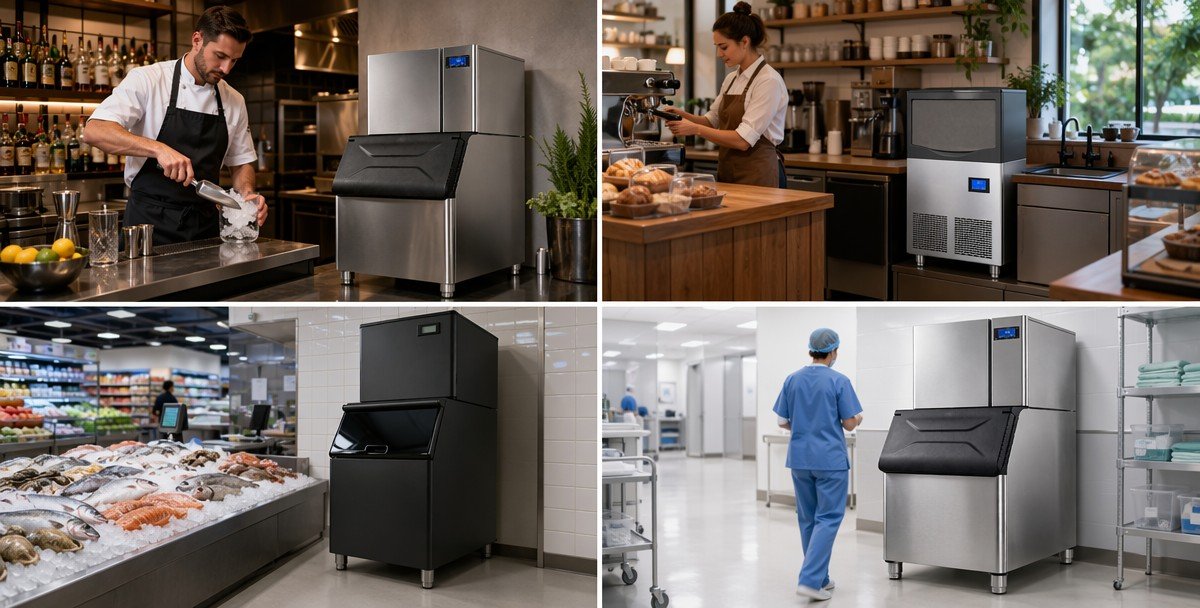
Selecting the commercial ice machine for restaurant use is one of the most significant equipment investments you will make. Underestimating your ice needs can lead to frustrated staff and disappointed customers, while over-purchasing can waste thousands in energy and water costs. In this guide, we break down exactly how to calculate your capacity, choose the right ice type, and plan the installation for your hospitality venue.
The Biggest Mistakes When Buying an Ice Machine
Most restaurant and hotel owners make two common errors: buying based solely on price and ignoring the “ice melt” factor. A restaurant ice maker machine is rated by its 24-hour output, but this rating is often based on ideal conditions (21°C air and 10°C water). In a hot kitchen where temperatures can reach 35°C, that 500kg machine might only produce 380kg to 400kg. Always look for a machine with a slightly higher capacity (roughly 20% more) than your peak demand to account for environmental factors.
Another mistake is neglecting the bin size. Production capacity is how much ice the machine makes in 24 hours, but storage capacity is how much it can hold at one time. If you have a high-volume lunch rush, you need a bin that can hold enough ice to survive that surge, even if the machine is still producing more for the dinner shift.
How Much Ice Does a Restaurant Need Per Day?
To calculate the right capacity for your venue, use these industry-standard benchmarks. These formulas help you find the perfect commercial ice machine without the guesswork. Remember, these are daily averages; peak weekend demand might be 25% higher.
Restaurant Calculation Formula
For a standard restaurant, the benchmark is 0.5kg to 1kg of ice per cover (seat). This accounts for ice in water, sodas, and a small amount of waste in the ice bin.
- Quick Service (QSR): 0.4kg per customer. These venues usually serve more sodas but use smaller cups.
- Full Service Dining: 0.7kg per customer. Includes water service, cocktails, and table-side wine buckets.
- Bar/Lounge: 1.5kg per customer. High ice usage for cocktails, rocks drinks, and heavy bottle service cooling.
- Cafeteria/Buffet: 0.5kg per customer + ice for display beds (seafood/salads).
Example: A 100-seat restaurant with two turnovers at lunch and dinner (400 covers total) needs roughly 280kg to 400kg of ice per day. A machine like our AZ-CIM500 would be the appropriate choice.
Hotel Calculation Formula
For a hotel ice machine commercial setup, the calculation shifts to room count. The standard is 2kg to 5kg per room, depending on the service level.
- Economy Hotel: 2kg per room. Guests typically use floor dispensers for small buckets.
- Standard Hotel: 3kg per room. Accounts for more frequent guest usage and a small lobby bar.
- Luxury Resort: 5kg+ per room. Accounts for high room service demand, multiple bars, and larger ice buckets for in-room celebrations.
Ice Type Recommendations by Venue
Not all ice is created equal. The type of ice you choose affects the customer’s perception of your brand and the operational efficiency of your staff.
1. Fine Dining & Upscale Restaurants
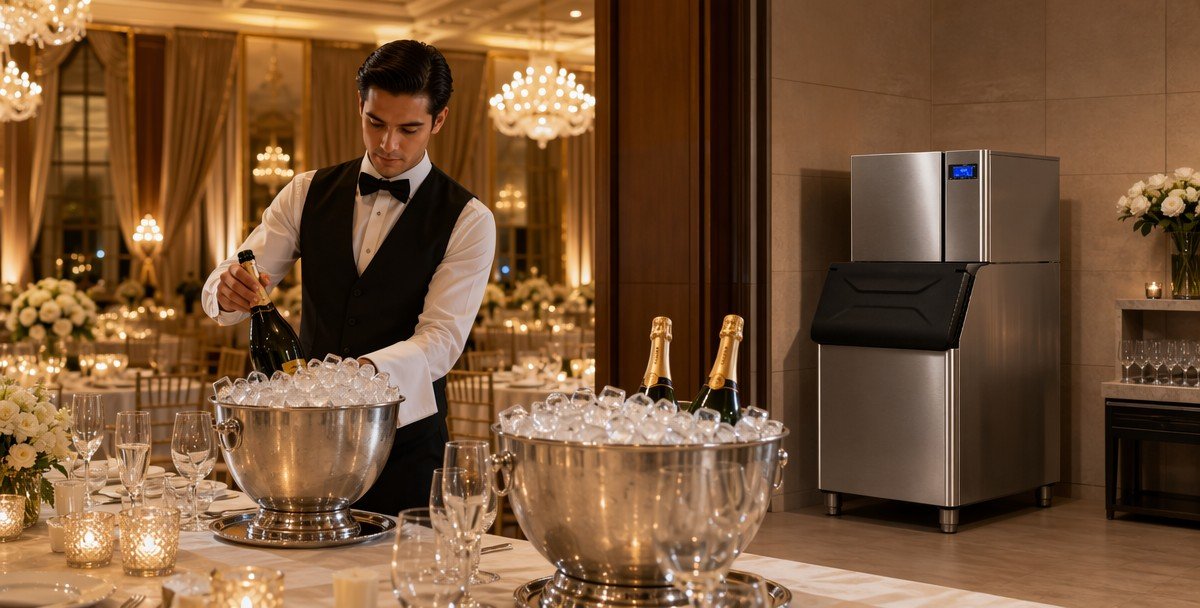
For high-end venues, a commercial cube ice machine (AZ-CIM series) is the standard. It provides crystal-clear, slow-melting ice that keeps premium drinks cold without excessive dilution. The square shape also fits perfectly into “on the rocks” glasses, providing a classic, sophisticated look.
2. Hotel Bars & Lounges
A mix is often best. Use cubes for spirits and a commercial nugget ice machine for specialty mojitos, smoothies, or blended drinks. The commercial ice machine for bar settings must be quiet and reliable, often requiring a water-cooled model to keep noise levels down in the front-of-house area.
3. Hotel Banquets & Buffets
For large-scale events, you need high-capacity split units. These separate the ice maker (the head) from the storage bin, allowing for production of 500kg to 1,000kg+ per day. If you serve seafood buffets or elaborate salad bars, you will also need a commercial flake ice machine (AZ-FIM) to keep products fresh. Flake ice molds easily around platters and stays cold longer than crushed cubes.
Advanced Installation Planning: Where to Put the Machine?
The location of your ice machine manufacturer‘s unit is just as important as the model itself. Poor placement leads to premature failure and high energy bills.
- The Heat Factor: Never place an ice machine next to an oven, fryer, or dishwasher. The hot ambient air forces the machine to work twice as hard, reducing ice production and shortening the life of the compressor.
- Ventilation: Most commercial units are air-cooled. They need at least 20cm of space around the intake and exhaust vents. Placing a machine in a closet without ventilation is a recipe for a breakdown.
- Accessibility: Ensure there is enough room to open the bin door fully and for staff to scoop ice comfortably. Also, leave room for a technician to access the back and sides for semi-annual cleaning.
- Drainage and Water: You need a cold water supply with a shut-off valve and a floor drain within 2 meters. The drain line must have an “air gap” to prevent backflow into the ice bin, which is a major health code violation.
Recommended Models by Venue Size
| Venue Type | Recommended Model | Capacity (24h) | Ice Type | Key Advantage |
|---|---|---|---|---|
| Small Cafe (20-40 seats) | AZ-CIM50 | 50 kg | Cube | Compact under-counter design |
| Medium Restaurant (80-120 seats) | AZ-CIM120 | 120 kg | Cube | High production, small footprint |
| Large Hotel (150+ rooms) | AZ-CIM500 / AZ-CIM800 | 500-800 kg | Cube | Split unit for massive storage |
| Seafood Buffet / Food Processing | AZ-FIM500 | 500 kg | Flake | Maximum surface area for cooling |
| Healthcare / Fast Food | AZ-NIM150 | 150 kg | Nugget | Chewable, high-displacement ice |
Water Filtration: The Non-Negotiable Add-on
If you want your restaurant ice maker machine to last more than three years, you must use a professional water filtration system. Ice is 99% water; if that water is full of minerals (hard water) or chlorine, your ice will taste bad, and your machine will scale up.
- Sediment Filter: Removes dirt, rust, and sand that can clog valves.
- Carbon Filter: Removes chlorine and organic chemicals that affect the smell and taste of the ice.
- Scale Inhibitor: Essential for preventing calcium buildup on the evaporator plate. Scale acts as an insulator, making it harder for the machine to freeze water, which increases electricity costs.
The Importance of Regular Maintenance
As a leading ice machine manufacturer, we recommend a strict maintenance schedule for all hospitality clients:
- Daily: Wipe down the exterior and the bin door gasket. Check for any unusual noises.
- Weekly: Clean the air filters (for air-cooled models). A dusty filter is the leading cause of “no ice” service calls.
- Semi-Annually: Perform a deep chemical descale and sanitize the internal water system. This kills mold and slime (often called “pink slime”) that can grow in the damp, dark environment of an ice bin.
Frequently Asked Questions (FAQ)
Should I choose air-cooled or water-cooled?
Air-cooled is the industry standard because it’s cheaper to install and uses less water. However, if your kitchen is consistently over 35°C, a water-cooled machine will be more efficient and produce ice more consistently, though it will increase your water bill.
How long should a commercial ice machine last?
With proper filtration and twice-yearly professional cleaning, a quality machine like the VendMachinery AZ series should last 7 to 10 years. Neglecting maintenance can cut this lifespan in half.
Can I install the machine myself?
While possible, we highly recommend professional installation. A technician ensures the water pressure is correct, the drain is properly vented, and the machine is perfectly level. An unlevel machine can cause the harvest cycle to fail.
What is the difference between a self-contained unit and a modular unit?
A self-contained unit has the ice maker and bin in one housing (like a refrigerator). A modular unit is just the ice maker “head” which sits on top of a separate, larger storage bin.
Why is my machine making less ice than the manual says?
Check your ambient air and water temperatures. If the room is hot or the water coming from the tap is warm, the machine takes longer to freeze each batch, lowering the total 24-hour production.
“In the hospitality industry, ice is not a luxury; it’s a utility. Reliability is the only metric that truly matters. When the ice stops, the service stops.” — VendMachinery Hospitality Experts
Stop running out of ice during the Friday night rush. Whether you are looking for a compact restaurant ice maker machine or a fleet of industrial units for a hotel chain, we provide factory-direct pricing and global shipping from our China manufacturing hub.
[Get a Free Ice Capacity Consultation]