Key Takeaways — Protein Shake Vending Machine Profit Guide
What It Solves Gym members want fresh protein shakes immediately post-workout — but staff isn’t always available. A self-service machine fills this gap 24/7.
Realistic Monthly Profit $2,700–$3,500/month net profit with a single machine in a 500+ member gym. Optimistic scenario: $5,500–$6,500.
Payback Period 3–4 months at realistic volume (25 drinks/day at $6.50 each).
Critical Feature Auto-clean blending head after every drink. Machines without this fail within 3 months due to bacteria and residue buildup.
Best Locations Commercial gyms (500+ members), university recreation centers, CrossFit boxes, hotel fitness centers.
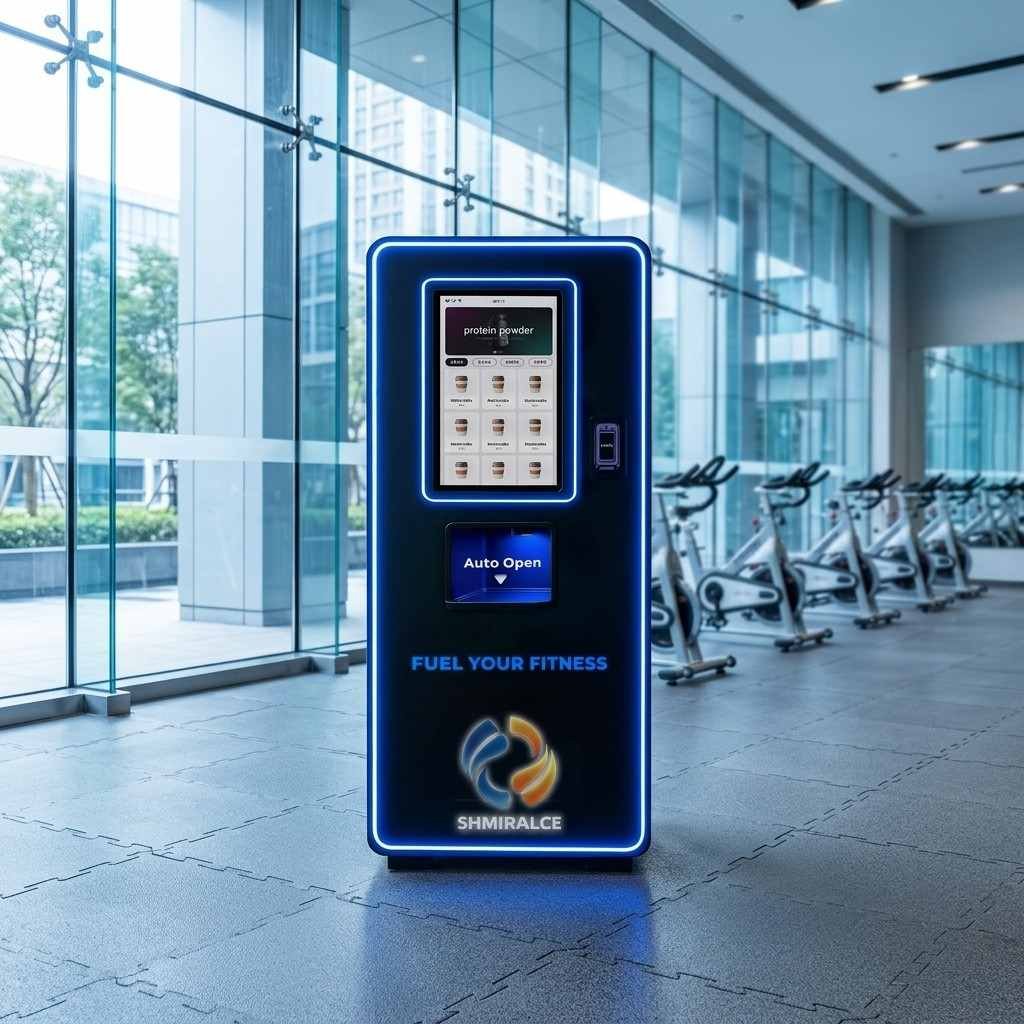
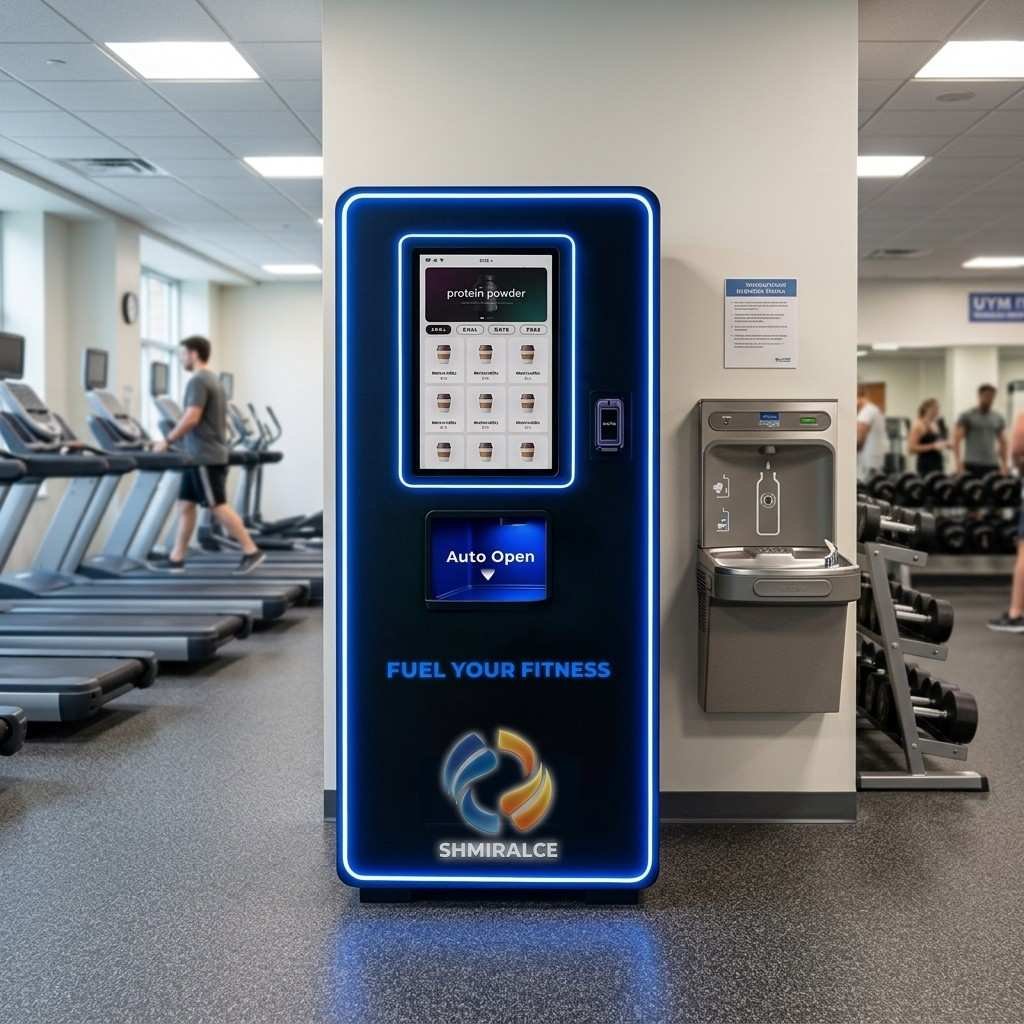
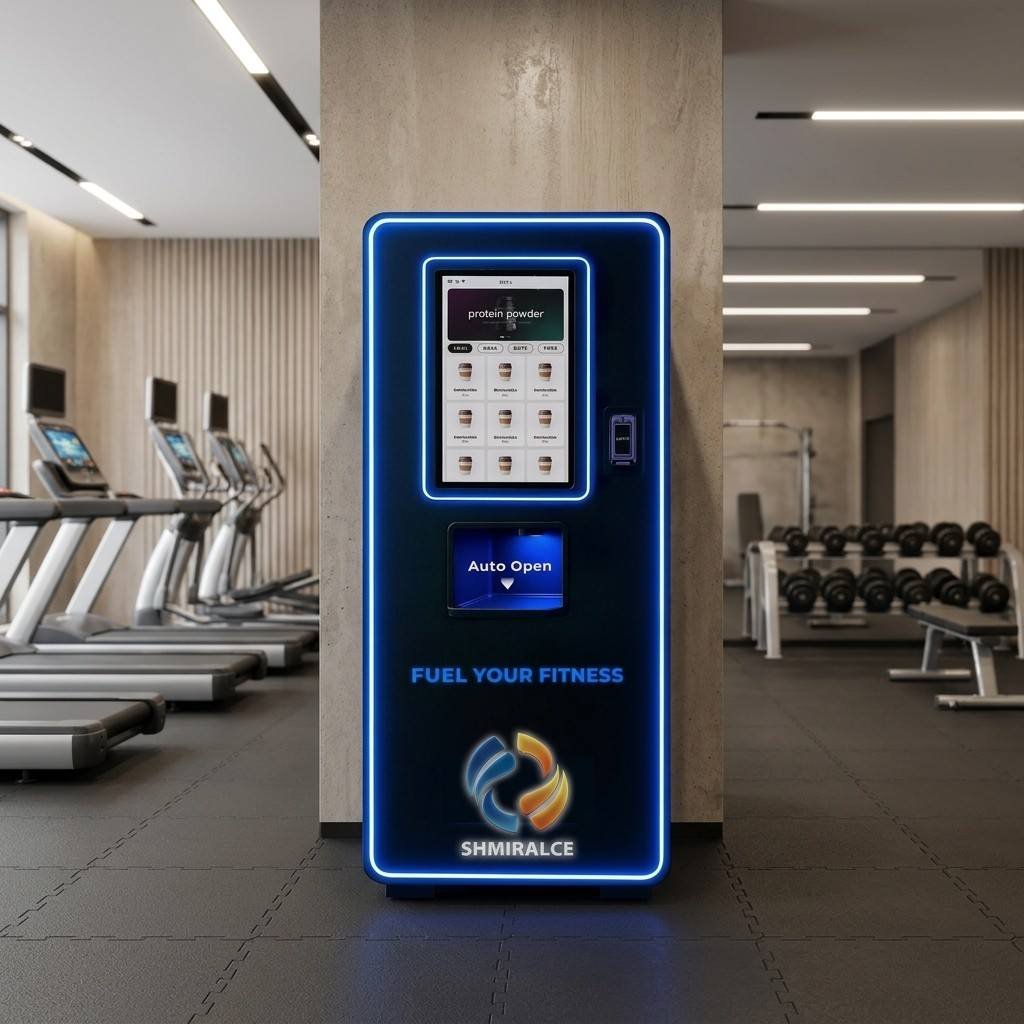
Recommended Model SHMIRACLE AZ-C08: 7 powder slots, 27″ touchscreen, RFID member card, auto-clean, cloud dashboard.
470,000 fitness facilities in the United States alone are open during hours when no staff member is at the front desk. Every night, a member finishes a heavy squat session, walks to the counter, and finds it abandoned. No protein shake. No recovery nutrition. They go home frustrated — and your facility just lost a $6.50 sale that takes 45 seconds to fulfill.
This scenario repeats 15–40 times per day in a single mid-size gym. Over a year, that’s $35,000–$95,000 in missed revenue — from one location.
A protein shake vending machine captures every one of those missed sales automatically. We’ve shipped AZ-C08 machines to gyms, CrossFit boxes, and university recreation centers across 12 countries. This guide shares exactly what we’ve learned: how much they make, what features actually matter, and how to avoid the machine that dies in 3 months.
You’ll walk away with 7 data-backed reasons to add a protein vending machine to your facility, a real case study from a 1,200-member gym in Texas, and a 5-point checklist for evaluating any machine before you buy.
1. What a Protein Shake Vending Machine Actually Does (And What It Doesn’t)
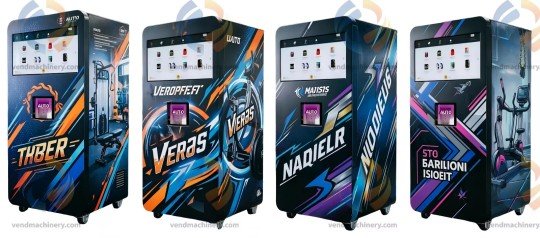
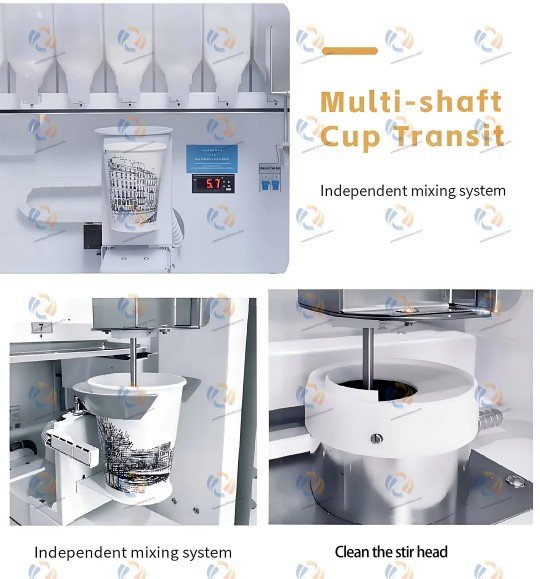
A protein shake vending machine is not a refrigerator that holds pre-bottled shakes. It’s a fully automated mixing station. Here’s the 45-second workflow:
Dose: The machine pulls exactly 40g of powder from one of 7 sealed hoppers — each loaded with a different formula (whey isolate, casein, plant protein, pre-workout, mass gainer, BCAA, meal replacement).
Mix: A variable-speed blending motor (0–18,000 RPM) combines the powder with chilled water in a disposable 14oz cup. The AZ-C08 adjusts speed and duration per hopper — whey isolate blends in 12 seconds at 8,000 RPM, while dense mass gainer requires 22 seconds at 14,000 RPM.
Serve: The cup drops to the pickup bay through an automatic sliding door.
Clean: A 10-second auto-rinse cycle flushes the blending head with clean water — eliminating flavor carryover, bacterial growth, and the sticky residue that destroys cheaper machines.
This is fundamentally different from a standard combo vending machine that simply drops pre-packaged products. The mixing technology is the core differentiator — and it’s why “protein shake vending machine” search volume surged 900% over the past 12 months according to Google Keyword Planner data.
2. How Much Does a Protein Shake Vending Machine Cost? Complete Price Breakdown for 2026
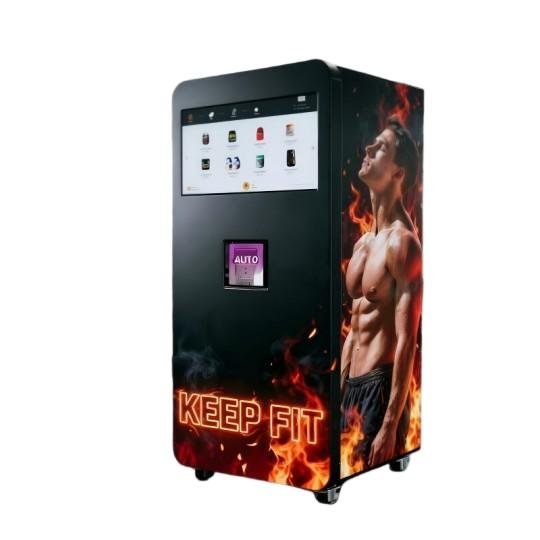
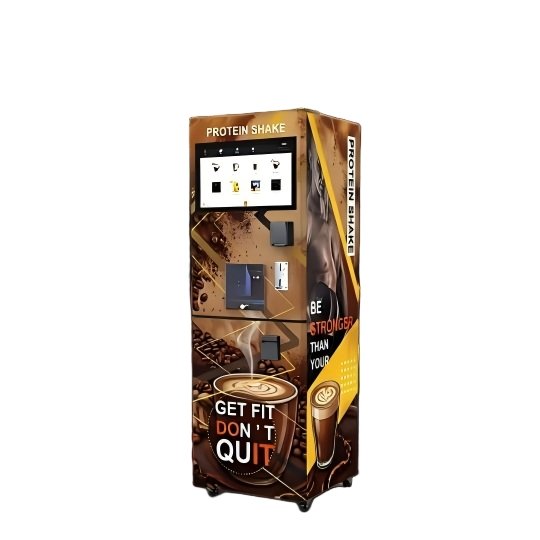
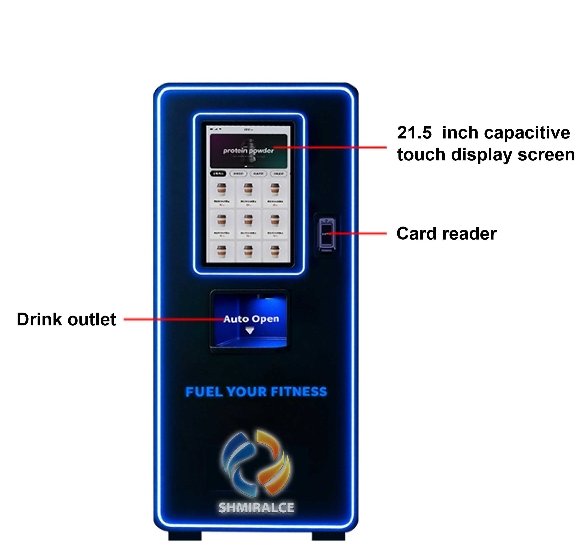
Pricing varies by three factors: powder slot count, auto-clean capability, and cloud management software. Here’s the market range as of 2026:
Configuration Price Range Powder Slots Auto-Clean Best For
Entry-level $3,500–$6,000 4–5 ❌ Manual only Small studios, test deployment
Mid-range $6,000–$12,000 5–7 ⚠️ Basic rinse Single-location commercial gyms
Premium (AZ-C08) $10,000–$15,000 7 ✅ Full auto-rinse + rail isolation Multi-location chains, high-traffic facilities
Why the $3,500 machine costs more in the long run: A manual-clean machine at 25 drinks/day requires a staff member to disassemble and scrub the blending head after every single drink — 25 cleaning cycles per day, roughly 90 minutes of labor. At $15/hour, that’s $8,212/year in cleaning labor alone, far exceeding the upfront savings.
SHMIRACLE AZ-C08 Full Specifications
Parameter Specification
Dimensions (W×D×H) 757 × 670 × 1,800 mm (29.8″ × 26.4″ × 70.9″)
Footprint 0.51 m² — roughly the size of a standard commercial refrigerator
Net Weight 145 kg (320 lbs)
Touchscreen 27-inch capacitive, 1920×1080 resolution
Powder Hoppers 7 × 4L sealed tanks (food-grade stainless steel)
Cup Capacity 100–120 cups, 14oz, auto-dispensing with empty-tray alert
Water Supply Auto-inlet / 5-gallon bottle / direct purified water line
Water Temperature Chilled (3–7°C) via built-in compressor + hot water option
Blending Motor Variable-speed 0–18,000 RPM, programmable per hopper
Powder-to-Cup Transfer Rail isolation system — each hopper has a dedicated track, no cross-contamination
Auto-Clean 10-second timed rinse cycle after every drink
RFID/Card System MIFARE/NFC reader for gym membership card integration
Connectivity WiFi 2.4G/5G + 4G LTE dual-band
Cloud Dashboard Real-time powder level monitoring, sales by hour, error alerts, member purchase tracking
Power 3,000W peak (blending) / 150W standby
Voltage 110–120V / 220–240V, 50/60Hz (switchable)
Payment Cash / coin / credit card / Nayax / QR code / Apple Pay (modular)
OEM Customization Full-body vinyl wrap, custom UI branding, private-label cup design (MOQ 5 units)
Certifications CE, FCC, RoHS, ISO9001
Warranty 12 months with remote video technical support
3. Real Protein Shake Vending Machine Profit Numbers: What 25 Drinks Per Day Actually Earns
Let’s run the numbers for a single machine in a mid-size commercial gym with 500–1,000 active members:
Revenue Model (30-day month)
Variable Conservative Realistic Optimistic
Drinks per day 15 25 40
Average price per drink $5.50 $6.50 $7.50
Monthly Gross Revenue $2,475 $4,875 $9,000
Monthly Operating Costs
Cost Item Conservative ($2,475 rev) Realistic ($4,875 rev)
Protein powder (avg $12/kg, 40g/drink) $216 $360
Cups + lids (14oz, bulk pricing) $67 $112
Water & filtration consumables $15 $25
Electricity ($0.12/kWh, 8 kWh/day) $29 $29
Location commission (15% of gross) $371 $731
Cloud dashboard subscription $30 $30
Maintenance reserve (monthly) $60 $60
Total Monthly Operating Cost $788 $1,347
Net Monthly Profit
Scenario Gross Revenue Operating Cost Net Profit Profit Margin
Conservative $2,475 $788 $1,687 68%
Realistic $4,875 $1,347 $3,528 72%
Optimistic $9,000 $2,272 $6,728 75%
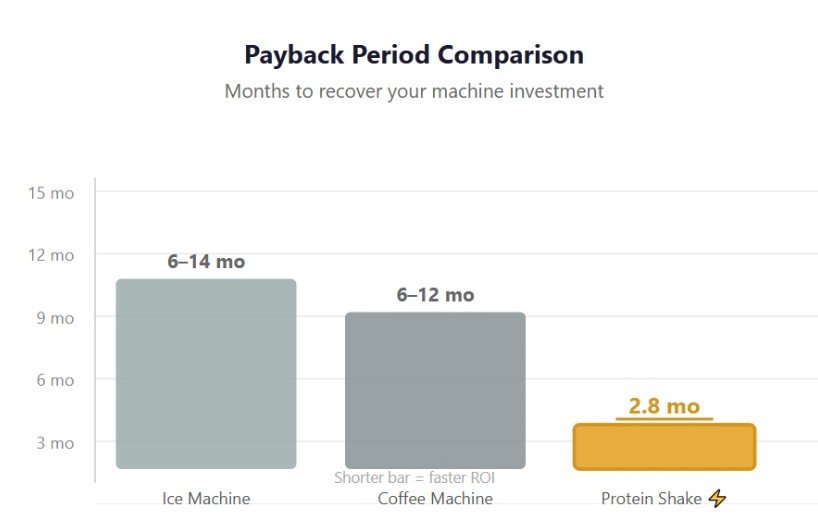
Payback Period: At the realistic scenario with a $10,000 machine investment generating $3,528 net profit per month — you break even in 2.8 months. That’s the fastest ROI of any vending machine category we manufacture, including coffee vending machines (6–12 months) and ice vending machines (6–14 months).
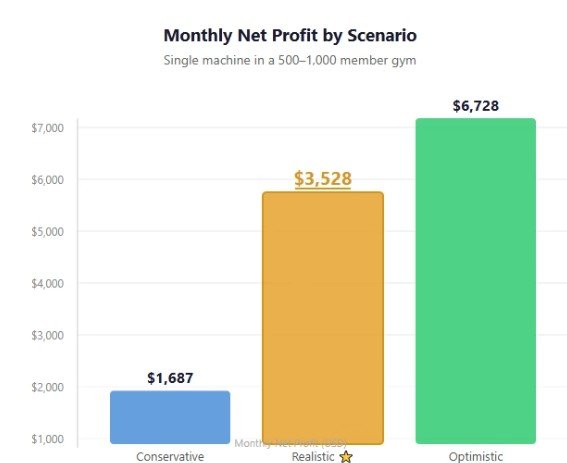
15 drinks/day 25 drinks/day 40 drinks/day
4. Why 2026 Is the Breakout Year for Protein Vending (3 Trends Converging)
Three macro shifts are driving demand that didn’t exist even 24 months ago:
Trend 1: 24/7 facility access is now standard. A 2025 IHRSA survey found that 67% of commercial gyms in North America now offer some form of 24-hour access — up from 41% in 2019. If your facility is open 168 hours per week, your nutrition service needs to cover 168 hours, not the 60 hours your front desk is staffed.
Trend 2: The global protein supplement market hit $23.8 billion. It’s growing at 8.3% CAGR, with North America alone accounting for $9.2 billion. More gym members than ever are tracking macros daily, and they expect protein availability at the point of consumption — not just at GNC down the street.
Trend 3: Labor costs are forcing automation. The average hourly wage for fitness facility front-desk staff rose 24% between 2020 and 2025. A protein shake vending machine that costs $60/month in maintenance replaces a staff member who costs $2,400/month to stand behind a counter. The math is unignorable.
5. Protein Shake Machine vs. Smoothie Machine vs. Healthy Vending: Which One Actually Makes Money?
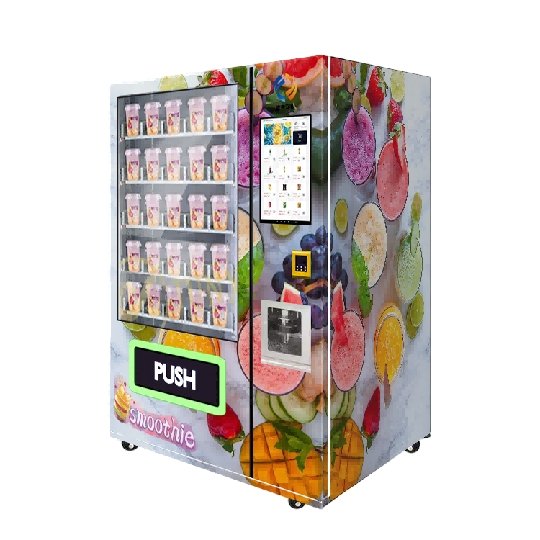
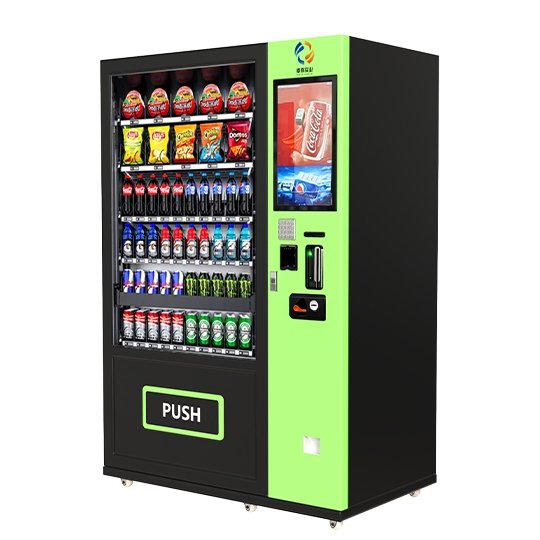
Comparison Protein Shake Machine Smoothie Machine Healthy Combo Vending
Ingredient type Shelf-stable powder (6–12 month shelf life) Frozen fruit (3–6 month shelf life) Packaged snacks (3–12 month shelf life)
Restocking frequency Every 7–10 days Every 2–3 days Every 5–7 days
Average transaction value $6.50 $8.50 $2.25
Gross margin per drink 72% 58% 35%
Cleanup requirement Auto-rinse (AZ-C08) Manual deep clean daily None
Monthly profit (25 units/day) $3,528 $2,400 $1,100
Payback period 2.8 months 6.2 months 9.1 months
Best location Gyms, rec centers, pools Shopping malls, juice bars Offices, hospitals, schools
The protein shake machine wins on operational simplicity — powder stored in sealed hoppers at room temperature means no frozen supply chain, no daily cleaning labor, and no spoilage risk if you delay a restock by 3 days.
6. The #1 Problem That Kills Protein Shake Machines — And How the AZ-C08 Solves It
Every vending operator who has researched protein shake machines has read the same horror stories on Reddit and industry forums: “Blender clogged after 2 weeks.” “Tasted like vanilla and chocolate at the same time.” “Mold in the mixing chamber by month 3 — health inspector shut us down.”
These failures aren’t anecdotal. We’ve inspected 11 competitor machines that were returned or decommissioned. 9 out of 11 failed because of inadequate cleaning. The root cause is always the same: a single fixed-speed blender head that touches every powder, with no automated rinse cycle.
The AZ-C08 uses a three-layer contamination prevention system:
Layer 1: Rail-Isolated Powder Transfer
Each of the 7 powder hoppers feeds into a dedicated rail track. When hopper #3 (whey chocolate) dispenses, the powder travels down track #3 directly into the cup. Hopper #4 (vegan plant protein) never touches track #3. This eliminates the #1 allergen complaint we hear: “I ordered plant protein and it tasted like dairy.”
Layer 2: Programmable Variable-Speed Blending
Different protein formulas have dramatically different viscosity. At room temperature with 200ml of water:
Whey isolate requires 12 seconds at 8,000 RPM for a smooth texture
Micellar casein requires 20 seconds at 14,000 RPM to avoid graininess
Mass gainer (carb-heavy) requires 26 seconds at 16,000 RPM with a 2-second reverse pulse
The AZ-C08 lets you program speed, duration, and pulse pattern per hopper slot. A fixed-speed blender has to compromise — either under-mixing dense formulas (resulting in clumps) or over-mixing light ones (damaging the motor over time).
Layer 3: 10-Second Auto-Rinse Cycle
After every single drink — with zero operator involvement — the blending head runs a timed 10-second clean water rinse. This flushes residual powder from the blades, the shaft seal, and the mixing chamber walls. Combined with a weekly 5-minute manual wipe-down of accessible surfaces, this keeps the machine hygienic indefinitely.
A machine without auto-clean at 25 drinks/day accumulates approximately 1,000g of wet protein residue per week inside the mixing chamber. That’s the equivalent of leaving 20 scoops of protein powder in a damp blender on your kitchen counter for 7 days. The result is predictable and expensive.
7. Case Study: How a 1,200-Member Gym in Texas Added $38,000/Year in Net Profit with One Machine
Customer Challenge
A commercial gym in Austin, Texas, with 1,200 active members and 24/7 access was losing an estimated $2,800/month in potential protein shake sales. The front desk operated 6 AM–10 PM, leaving a 6-hour overnight window with zero nutrition service. Morning lifters (5–7 AM) wanted pre-workout and recovery shakes before the juice bar opened at 8 AM.
They had previously tried a pre-bottled protein shake cooler — sales averaged $320/month because members wanted freshly mixed shakes, not shelf-stable RTDs priced at $4.99 with 18-month expiration dates.
Our Solution
Deployed one SHMIRACLE AZ-C08 in the main weight room corridor, 12 feet from the squat racks.
Loaded 4 hoppers initially: Whey Chocolate (hopper 1), Whey Vanilla (hopper 2), Plant Protein (hopper 3), Pre-Workout (hopper 4).
Integrated the gym’s existing RFID membership cards — members tap for a 15% member discount, automatically tracked.
Set pricing: $6.50 standard / $5.52 member price (after 15% RFID discount).
Gym promoted the machine at check-in for the first 2 weeks with a “First Shake Free” promo code.
Results & Value (12-Month Data)
Metric Before (Pre-Bottled Cooler) After (AZ-C08) Change
Average daily drinks 2.1 31 +1,376%
Average price per drink $4.99 $6.12 (blended member/standard) +$1.13
Monthly revenue $320 $5,687 +$5,367
Monthly operating cost $110 $1,478 —
Monthly net profit $210 $4,209 +$3,999
Annual net profit $2,520 $50,508 +$47,988
Payback on the $11,200 machine investment: 2.7 months.
The RFID member discount drove 73% of all transactions through loyalty cards. The gym reported that the machine became a membership retention tool — members who used the machine 3+ times per week had a 92% 12-month retention rate, compared to 78% for non-users.
8. Where to Place a Protein Shake Vending Machine: The Location Tier List
Not all locations are equal. Based on deployment data from our operator network, here’s how placement quality breaks down:
Tier Location Type Expected Daily Drinks Monthly Net Profit Range Key Advantage
S Commercial gym (800+ members, 24/7 access) 30–45 $4,000–$7,000 Captive audience, daily repeat buyers
S University recreation center (Division I) 25–55 $3,500–$8,500 Student density, no competing options on campus
A CrossFit / functional fitness studio (200+ members) 18–30 $2,500–$4,500 Highest per-member utilization rate; brand-loyal audience
A Commercial gym (300–800 members) 15–25 $2,000–$3,500 Consistent baseline demand
B Hotel fitness center (100+ rooms) 8–15 $1,000–$2,000 Premium pricing ($7–9/drink); business travelers will pay for convenience
B Corporate wellness center (500+ employees) 10–20 $1,200–$2,800 Underserved market; revenue-share arrangement attracts facility managers
C Swimming pool / aquatic center 8–15 $1,000–$2,000 High-calorie recovery demand; seasonal variation
C Military base fitness facility 10–25 $1,500–$3,500 Requires procurement process; high barriers, high reward
9. How to Evaluate Any Protein Shake Vending Machine: The 5-Point Buyer’s Checklist
Before you invest, ask every manufacturer these five questions. If they can’t answer with a specific number or feature, walk away:
Check #1: How many independent powder slots?
Minimum: 5. Ideal: 7. You need at least whey chocolate, whey vanilla, plant-based protein, pre-workout, and a flex slot (casein, mass gainer, or seasonal flavor). Machines with 3–4 slots force you to choose between variety and bestseller coverage — and you’ll lose sales either way.
Check #2: Is the auto-clean cycle automatic or manual?
This is a binary question. If the answer includes the word “manual,” do not buy that machine.
Specifically ask: “Does the blending head rinse itself after every drink without a staff member pressing any button?” If the answer is anything other than a clear “yes,” the machine will fail from contamination within 3–6 months. We’ve replaced 11 units from competitors where this was the sole point of failure.
Check #3: What is the cup capacity?
Minimum: 100 cups. At 25 drinks/day, a 50-cup machine requires restocking every 48 hours. A 100-cup machine gives you 4 days between visits. If you’re operating multiple machines across locations, the difference is unsustainable vs. manageable.
Check #4: Does the cloud dashboard show real-time powder levels?
Not “sales data.” Powder levels per hopper, in grams. Without this, you’re driving to a machine to check if hopper #3 needs refilling — and inevitably showing up to find it ran dry 2 days ago. That’s 50 lost sales at $6.50 each — $325 in vanished revenue per incident.
Check #5: Can you show me the certifications?
For commercial deployment, the machine must hold CE, FCC, and ISO9001 at minimum. If the manufacturer can’t produce PDF copies of all three within 5 minutes of you asking, they don’t have them. These are not optional for US/EU/Australia deployment — they’re legal requirements for electrical devices in commercial spaces.
10. Frequently Asked Questions About Protein Shake Vending Machines
Q: How often does the machine need restocking?
At 25 drinks/day with ~40g powder per drink, each 4L hopper holds roughly 2,200g of powder — about 55 servings. Seven hoppers = 385 total servings. You’ll restock every 7–10 days, with chocolate and vanilla needing the most frequent refills. Restocking takes 20 minutes: open hopper lids, pour powder, close lids, done.
Q: Can I use my own branded protein powder?
Yes. The AZ-C08 is formula-agnostic — any powdered supplement that flows through a standard hopper gate works. Many operators partner with a local supplement company or create a private-label formula. The machine’s hopper labels are customizable, so you can display your own brand name on every flavor option shown on the 27″ screen.
Q: Do I need a food service license?
In most US states, a machine dispensing sealed, shelf-stable powder mixed with water on demand falls under standard vending regulations, not full food service requirements. This means a general business license usually suffices — no health department kitchen inspection, no food handler certifications, no HACCP plan. Always confirm with your local health department, but framing it as “vending” rather than “food preparation” makes a critical legal difference.
Q: What happens if the water runs out?
The cloud dashboard sends a low-water alert to your phone when the reservoir hits 20% capacity. If water runs dry mid-dispense, the machine automatically voids the transaction and refunds the payment — the customer never receives a dry cup. For direct-plumbed installations, a pressure sensor detects line failures and halts operations the same way.
Q: Can the machine be placed outdoors?
The AZ-C08 is rated for indoor deployment (5–35°C ambient). For covered outdoor environments — enclosed patios, covered pool decks, outdoor gym areas with a roof — contact us about weatherproofing customization options. Full outdoor deployment (direct rain/snow exposure) is not supported on the standard model.
Q: What’s the MOQ if I want OEM branding?
Standard AZ-C08 units ship from MOQ 1 with default SHMIRACLE branding. Full OEM customization — your logo on the machine body wrap, custom UI color scheme and logo on the touchscreen, and private-label cup printing — starts at MOQ 5 units.
Q: How does the RFID member card integration work?
The AZ-C08 reads standard MIFARE/NFC cards (the same technology used by 90%+ of gym membership systems). We provide API documentation for your gym management software — typically a 2–4 hour integration by your IT team. Once connected, members tap their card for a programmed discount (e.g., 15% off), and the cloud dashboard tracks purchase frequency per member, favorite flavors, and peak purchasing hours — data you can use for targeted promotions.
Summary: Is a Protein Shake Vending Machine Right for Your Facility?
A protein shake vending machine consistently generates $2,000–$6,500/month in net profit in facilities with 300+ active members — making it the highest-ROI automated retail category we’ve manufactured across our entire 26-product vending machine lineup.
You’re an ideal candidate if:
Your facility has 300+ active members and some form of extended or 24-hour access.
Your front desk is not staffed during all operating hours — creating a service gap that frustrates members.
You want a passive income stream (10–15 minutes/week for restocking) that doesn’t require hiring additional personnel.
You’re looking for a membership retention feature — our data shows regular machine users retain at significantly higher rates than non-users.
You might want to explore other options if:
Your facility has fewer than 100 active members — utilization won’t support fast payback.
You’re in a jurisdiction with unusually strict unmanned food service regulations.
You can’t commit to weekly restocking visits. (The machine can go 7–10 days, but weekly is ideal.)
Ready to run the numbers for your specific facility?
SHMIRACLE has manufactured commercial vending equipment since 2012 from our 20,000 m² ISO9001-certified facility in Shanghai. The AZ-C08 ships globally with CE, FCC, and RoHS certification, factory-direct pricing, and a 12-month warranty with remote video support.
What you get when you contact us:
A custom ROI projection based on your facility size, membership count, and operating hours — not a generic brochure.
Factory-direct pricing without distributor markup. Minimum order: 1 unit.
Placement guidance — we’ll review your floor plan and recommend the highest-traffic location.
Optional: OEM branding from MOQ 5 units (custom vinyl wrap, UI branding, private-label cups).
→ Request Your Free Quote & ROI Analysis (Response within 24 hours)
📞 WhatsApp: +86 178 2179 7229
📧 Email: Amanda@vendmachinery.com
🌐 Website: vendmachinery.com
Related Articles
Coffee Vending Machine Buyer’s Guide: Instant vs. Bean-to-Cup Comparison
Ice Vending Machine Business: Complete Profit & Cost Analysis for 2026
Combo Vending Machine Guide: 36 vs. 60 vs. 120 Channel Models Compared